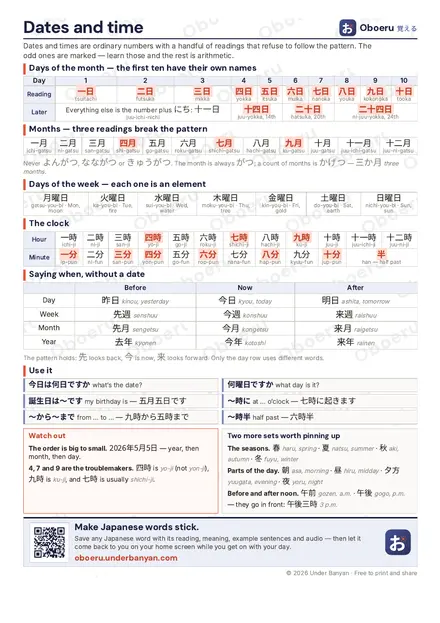
Days of the month — the first ten have their own names
| Day | 1 | 2 | 3 | 4 | 5 | 6 | 7 | 8 | 9 | 10 |
|---|---|---|---|---|---|---|---|---|---|---|
| Reading | 一日tsuitachi | 二日futsuka | 三日mikka | 四日yokka | 五日itsuka | 六日muika | 七日nanoka | 八日youka | 九日kokonoka | 十日tooka |
| Later | Everything else is the number plus にち: 十一日 juu-ichi-nichi | 十四日juu-yokka, 14th | 二十日hatsuka, 20th | 二十四日ni-juu-yokka, 24th | ||||||
Months — three readings break the pattern
| 一月ichi-gatsu | 二月ni-gatsu | 三月san-gatsu | 四月shi-gatsu | 五月go-gatsu | 六月roku-gatsu | 七月shichi-gatsu | 八月hachi-gatsu | 九月ku-gatsu | 十月juu-gatsu | 十一月juu-ichi-gatsu | 十二月juu-ni-gatsu |
Never よんがつ, なながつ or きゅうがつ. The month is always がつ; a count of months is かげつ — 三か月 three months.
Days of the week — each one is an element
| 月曜日getsu-you-bi · Mon, moon | 火曜日ka-you-bi · Tue, fire | 水曜日sui-you-bi · Wed, water | 木曜日moku-you-bi · Thu, tree | 金曜日kin-you-bi · Fri, gold | 土曜日do-you-bi · Sat, earth | 日曜日nichi-you-bi · Sun, sun |
The clock
| Hour | 一時ichi-ji | 二時ni-ji | 三時san-ji | 四時yo-ji | 五時go-ji | 六時roku-ji | 七時shichi-ji | 八時hachi-ji | 九時ku-ji | 十時juu-ji | 十一時juu-ichi-ji | 十二時juu-ni-ji |
| Minute | 一分ip-pun | 二分ni-fun | 三分san-pun | 四分yon-pun | 五分go-fun | 六分rop-pun | 七分nana-fun | 八分hap-pun | 九分kyuu-fun | 十分jup-pun | 半han — half past | |
Saying when, without a date
| Before | Now | After | |
|---|---|---|---|
| Day | 昨日 kinou, yesterday | 今日 kyou, today | 明日 ashita, tomorrow |
| Week | 先週 senshuu | 今週 konshuu | 来週 raishuu |
| Month | 先月 sengetsu | 今月 kongetsu | 来月 raigetsu |
| Year | 去年 kyonen | 今年 kotoshi | 来年 rainen |
The pattern holds: 先 looks back, 今 is now, 来 looks forward. Only the day row uses different words.
Use it
今日は何日ですか what’s the date?
何曜日ですか what day is it?
誕生日は~です my birthday is — 五月五日です
~時に at … o’clock — 七時に起きます
~から~まで from … to … — 九時から五時まで
~時半 half past — 六時半
Watch out
The order is big to small. 2026年5月5日 — year, then month, then day.
4, 7 and 9 are the troublemakers. 四時 is yo-ji (not yon-ji), 九時 is ku-ji, and 七時 is usually shichi-ji.
Two more sets worth pinning up
The seasons. 春 haru, spring · 夏 natsu, summer · 秋 aki, autumn · 冬 fuyu, winter
Parts of the day. 朝 asa, morning · 昼 hiru, midday · 夕方 yuugata, evening · 夜 yoru, night
Before and after noon. 午前 gozen, a.m. · 午後 gogo, p.m. — they go in front: 午後三時 3 p.m.