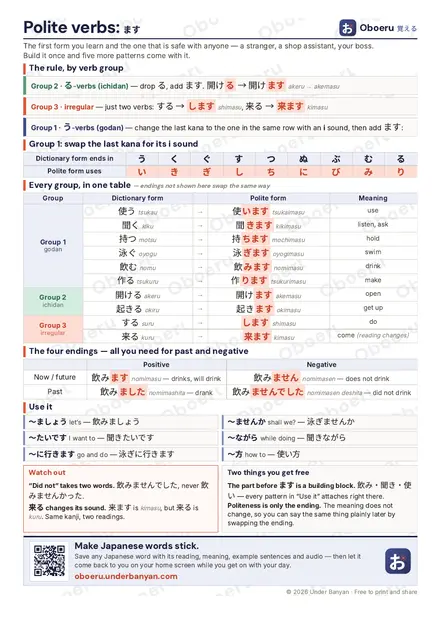
The rule, by verb group
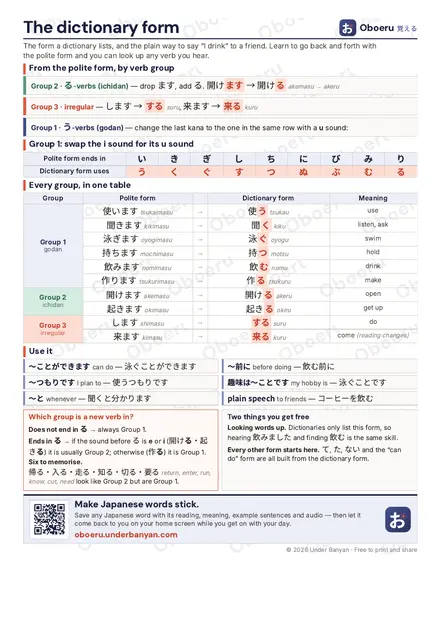
Group 2 · る-verbs (ichidan) — drop る, add ます. 開ける → 開けます akeru → akemasu
Group 3 · irregular — just two verbs: する → します shimasu, 来る → 来ます kimasu
Group 1 · う-verbs (godan) — change the last kana to the one in the same row with an i sound, then add ます:
Group 1: swap the last kana for its i sound
| Dictionary form ends in | う | く | ぐ | す | つ | ぬ | ぶ | む | る |
|---|---|---|---|---|---|---|---|---|---|
| Polite form uses | い | き | ぎ | し | ち | に | び | み | り |
Every group, in one table — endings not shown here swap the same way
| Group | Dictionary form | Polite form | Meaning | |
|---|---|---|---|---|
| Group 1godan | 使う tsukau | → | 使います tsukaimasu | use |
| 聞く kiku | → | 聞きます kikimasu | listen, ask | |
| 持つ motsu | → | 持ちます mochimasu | hold | |
| 泳ぐ oyogu | → | 泳ぎます oyogimasu | swim | |
| 飲む nomu | → | 飲みます nomimasu | drink | |
| 作る tsukuru | → | 作ります tsukurimasu | make | |
| Group 2ichidan | 開ける akeru | → | 開けます akemasu | open |
| 起きる okiru | → | 起きます okimasu | get up | |
| Group 3irregular | する suru | → | します shimasu | do |
| 来る kuru | → | 来ます kimasu | come (reading changes) |
The four endings — all you need for past and negative
| Positive | Negative | |
|---|---|---|
| Now / future | 飲みます nomimasu — drinks, will drink | 飲みません nomimasen — does not drink |
| Past | 飲みました nomimashita — drank | 飲みませんでした nomimasen deshita — did not drink |
Use it
~ましょう let’s — 飲みましょう
~ませんか shall we? — 泳ぎませんか
~たいです I want to — 聞きたいです
~ながら while doing — 聞きながら
~に行きます go and do — 泳ぎに行きます
~方 how to — 使い方
Watch out
“Did not” takes two words. 飲みませんでした, never 飲みませんかった.
来る changes its sound. 来ます is kimasu, but 来る is kuru. Same kanji, two readings.
Two things you get free
The part before ます is a building block. 飲み・聞き・使い — every pattern in “Use it” attaches right there.
Politeness is only the ending. The meaning does not change, so you can say the same thing plainly later by swapping the ending.