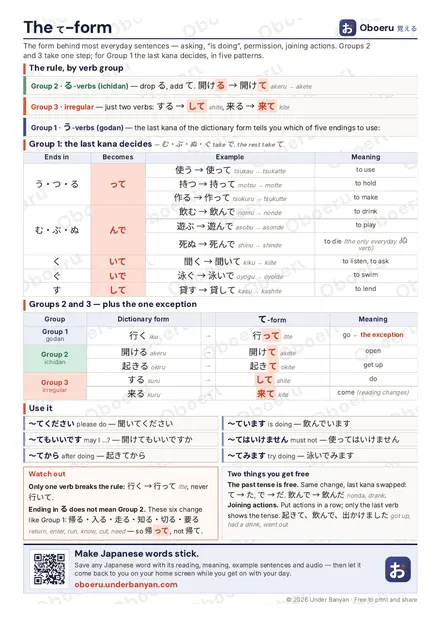
The rule, by verb group
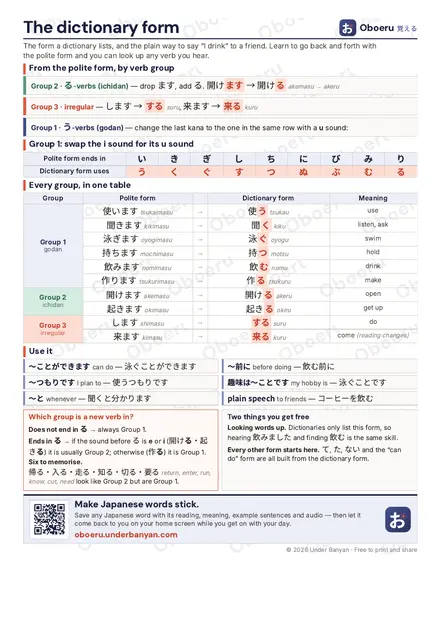
Group 2 · る-verbs (ichidan) — drop る, add て. 開ける → 開けて akeru → akete
Group 3 · irregular — just two verbs: する → して shite, 来る → 来て kite
Group 1 · う-verbs (godan) — the last kana of the dictionary form tells you which of five endings to use:
Group 1: the last kana decides — む・ぶ・ぬ・ぐ take で, the rest take て
| Ends in | Becomes | Example | Meaning |
|---|---|---|---|
| う・つ・る | って | 使う → 使って tsukau → tsukatte | to use |
| 持つ → 持って motsu → motte | to hold | ||
| 作る → 作って tsukuru → tsukutte | to make | ||
| む・ぶ・ぬ | んで | 飲む → 飲んで nomu → nonde | to drink |
| 遊ぶ → 遊んで asobu → asonde | to play | ||
| 死ぬ → 死んで shinu → shinde | to die (the only everyday ぬ verb) | ||
| く | いて | 聞く → 聞いて kiku → kiite | to listen, to ask |
| ぐ | いで | 泳ぐ → 泳いで oyogu → oyoide | to swim |
| す | して | 貸す → 貸して kasu → kashite | to lend |
Groups 2 and 3 — plus the one exception
| Group | Dictionary form | て-form | Meaning | |
|---|---|---|---|---|
| Group 1godan | 行く iku | → | 行って itte | go ← the exception |
| Group 2ichidan | 開ける akeru | → | 開けて akete | open |
| 起きる okiru | → | 起きて okite | get up | |
| Group 3irregular | する suru | → | して shite | do |
| 来る kuru | → | 来て kite | come (reading changes) |
Use it
~てください please do — 聞いてください
~ています is doing — 飲んでいます
~てもいいです may I …? — 開けてもいいですか
~てはいけません must not — 使ってはいけません
~てから after doing — 起きてから
~てみます try doing — 泳いでみます
Watch out
Only one verb breaks the rule: 行く → 行って itte, never 行いて.
Ending in る does not mean Group 2. These six change like Group 1: 帰る・入る・走る・知る・切る・要る return, enter, run, know, cut, need — so 帰って, not 帰て.
Two things you get free
The past tense is free. Same change, last kana swapped: て → た, で → だ. 飲んで → 飲んだ nonda, drank.
Joining actions. Put actions in a row; only the last verb shows the tense. 起きて、飲んで、出かけました got up, had a drink, went out