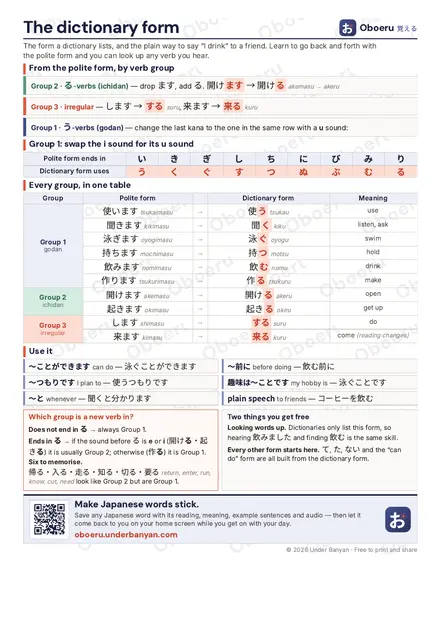
From the polite form, by verb group
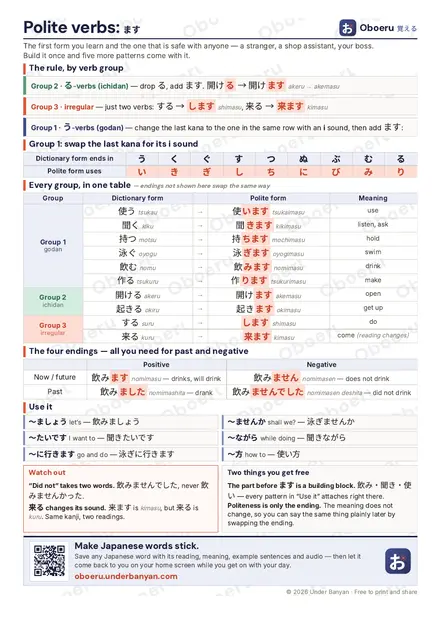
Group 2 · る-verbs (ichidan) — drop ます, add る. 開けます → 開ける akemasu → akeru
Group 3 · irregular — します → する suru, 来ます → 来る kuru
Group 1 · う-verbs (godan) — change the last kana to the one in the same row with a u sound:
Group 1: swap the i sound for its u sound
| Polite form ends in | い | き | ぎ | し | ち | に | び | み | り |
|---|---|---|---|---|---|---|---|---|---|
| Dictionary form uses | う | く | ぐ | す | つ | ぬ | ぶ | む | る |
Every group, in one table
| Group | Polite form | Dictionary form | Meaning | |
|---|---|---|---|---|
| Group 1godan | 使います tsukaimasu | → | 使う tsukau | use |
| 聞きます kikimasu | → | 聞く kiku | listen, ask | |
| 泳ぎます oyogimasu | → | 泳ぐ oyogu | swim | |
| 持ちます mochimasu | → | 持つ motsu | hold | |
| 飲みます nomimasu | → | 飲む nomu | drink | |
| 作ります tsukurimasu | → | 作る tsukuru | make | |
| Group 2ichidan | 開けます akemasu | → | 開ける akeru | open |
| 起きます okimasu | → | 起きる okiru | get up | |
| Group 3irregular | します shimasu | → | する suru | do |
| 来ます kimasu | → | 来る kuru | come (reading changes) |
Use it
~ことができます can do — 泳ぐことができます
~前に before doing — 飲む前に
~つもりです I plan to — 使うつもりです
趣味は~ことです my hobby is — 泳ぐことです
~と whenever — 聞くと分かります
plain speech to friends — コーヒーを飲む
Which group is a new verb in?
Does not end in る → always Group 1.
Ends in る → if the sound before る is e or i (開ける・起きる) it is usually Group 2; otherwise (作る) it is Group 1.
Six to memorise. 帰る・入る・走る・知る・切る・要る return, enter, run, know, cut, need look like Group 2 but are Group 1.
Two things you get free
Looking words up. Dictionaries only list this form, so hearing 飲みました and finding 飲む is the same skill.
Every other form starts here. て, た, ない and the “can do” form are all built from the dictionary form.