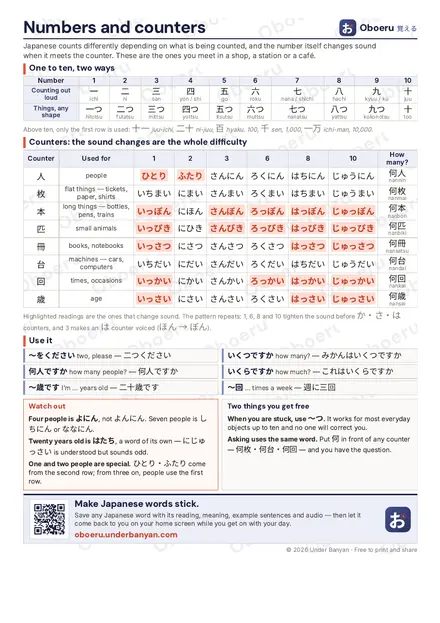
One to ten, two ways
| Number | 1 | 2 | 3 | 4 | 5 | 6 | 7 | 8 | 9 | 10 |
|---|---|---|---|---|---|---|---|---|---|---|
| Counting out loud | 一ichi | 二ni | 三san | 四yon / shi | 五go | 六roku | 七nana / shichi | 八hachi | 九kyuu / ku | 十juu |
| Things, any shape | 一つhitotsu | 二つfutatsu | 三つmittsu | 四つyottsu | 五つitsutsu | 六つmuttsu | 七つnanatsu | 八つyattsu | 九つkokonotsu | 十too |
Above ten, only the first row is used: 十一 juu-ichi, 二十 ni-juu, 百 hyaku, 100, 千 sen, 1,000, 一万 ichi-man, 10,000.
Counters: the sound changes are the whole difficulty
| Counter | Used for | 1 | 2 | 3 | 6 | 8 | 10 | How many? |
|---|---|---|---|---|---|---|---|---|
| 人 | people | ひとり | ふたり | さんにん | ろくにん | はちにん | じゅうにん | 何人nannin |
| 枚 | flat things — tickets, paper, shirts | いちまい | にまい | さんまい | ろくまい | はちまい | じゅうまい | 何枚nanmai |
| 本 | long things — bottles, pens, trains | いっぽん | にほん | さんぼん | ろっぽん | はっぽん | じゅっぽん | 何本nanbon |
| 匹 | small animals | いっぴき | にひき | さんびき | ろっぴき | はっぴき | じゅっぴき | 何匹nanbiki |
| 冊 | books, notebooks | いっさつ | にさつ | さんさつ | ろくさつ | はっさつ | じゅっさつ | 何冊nansatsu |
| 台 | machines — cars, computers | いちだい | にだい | さんだい | ろくだい | はちだい | じゅうだい | 何台nandai |
| 回 | times, occasions | いっかい | にかい | さんかい | ろっかい | はっかい | じゅっかい | 何回nankai |
| 歳 | age | いっさい | にさい | さんさい | ろくさい | はっさい | じゅっさい | 何歳nansai |
Highlighted readings are the ones that change sound. The pattern repeats: 1, 6, 8 and 10 tighten the sound before か・さ・は counters, and 3 makes an は counter voiced (ほん → ぼん).
Use it
~をください two, please — 二つください
いくつですか how many? — みかんはいくつですか
何人ですか how many people? — 何人ですか
いくらですか how much? — これはいくらですか
~歳です I’m … years old — 二十歳です
~回 … times a week — 週に三回
Watch out
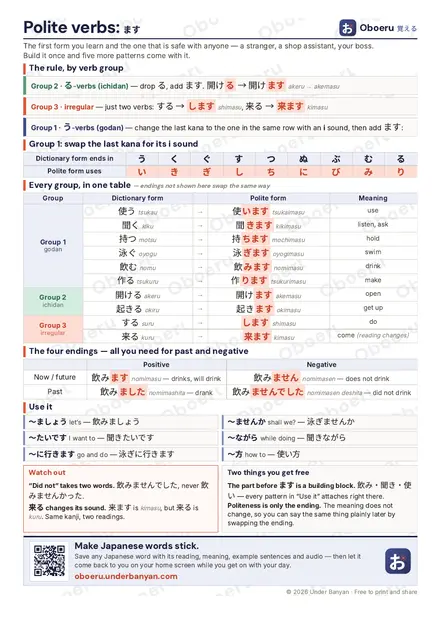
Four people is よにん, not よんにん. Seven people is しちにん or ななにん.
Twenty years old is はたち, a word of its own — にじゅっさい is understood but sounds odd.
One and two people are special. ひとり・ふたり come from the second row; from three on, people use the first row.
Two things you get free
When you are stuck, use ~つ. It works for most everyday objects up to ten and no one will correct you.
Asking uses the same word. Put 何 in front of any counter — 何枚・何台・何回 — and you have the question.