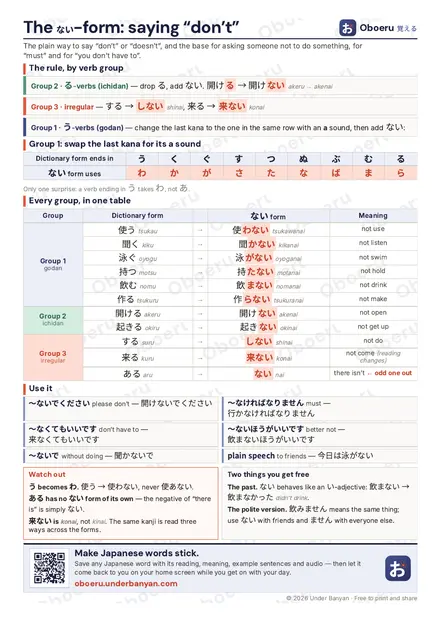
The rule, by verb group
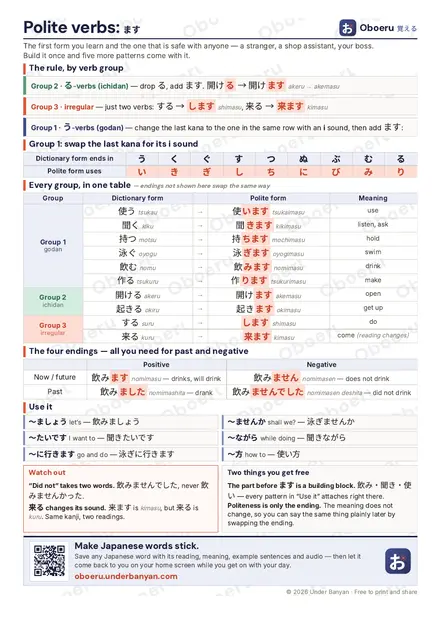
Group 2 · る-verbs (ichidan) — drop る, add ない. 開ける → 開けない akeru → akenai
Group 3 · irregular — する → しない shinai, 来る → 来ない konai
Group 1 · う-verbs (godan) — change the last kana to the one in the same row with an a sound, then add ない:
Group 1: swap the last kana for its a sound
| Dictionary form ends in | う | く | ぐ | す | つ | ぬ | ぶ | む | る |
|---|---|---|---|---|---|---|---|---|---|
| ない form uses | わ | か | が | さ | た | な | ば | ま | ら |
Only one surprise: a verb ending in う takes わ, not あ.
Every group, in one table
| Group | Dictionary form | ない form | Meaning | |
|---|---|---|---|---|
| Group 1godan | 使う tsukau | → | 使わない tsukawanai | not use |
| 聞く kiku | → | 聞かない kikanai | not listen | |
| 泳ぐ oyogu | → | 泳がない oyoganai | not swim | |
| 持つ motsu | → | 持たない motanai | not hold | |
| 飲む nomu | → | 飲まない nomanai | not drink | |
| 作る tsukuru | → | 作らない tsukuranai | not make | |
| Group 2ichidan | 開ける akeru | → | 開けない akenai | not open |
| 起きる okiru | → | 起きない okinai | not get up | |
| Group 3irregular | する suru | → | しない shinai | not do |
| 来る kuru | → | 来ない konai | not come (reading changes) | |
| ある aru | → | ない nai | there isn’t ← odd one out |
Use it
~ないでください please don’t — 開けないでください
~なければなりません must — 行かなければなりません
~なくてもいいです don’t have to — 来なくてもいいです
~ないほうがいいです better not — 飲まないほうがいいです
~ないで without doing — 聞かないで
plain speech to friends — 今日は泳がない
Watch out
う becomes わ. 使う → 使わない, never 使あない.
ある has no ない form of its own — the negative of “there is” is simply ない.
来ない is konai, not kinai. The same kanji is read three ways across the forms.
Two things you get free
The past. ない behaves like an い-adjective: 飲まない → 飲まなかった didn’t drink.
The polite version. 飲みません means the same thing; use ない with friends and ません with everyone else.