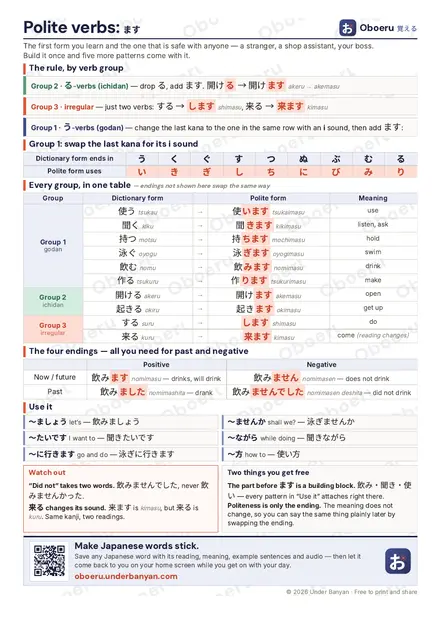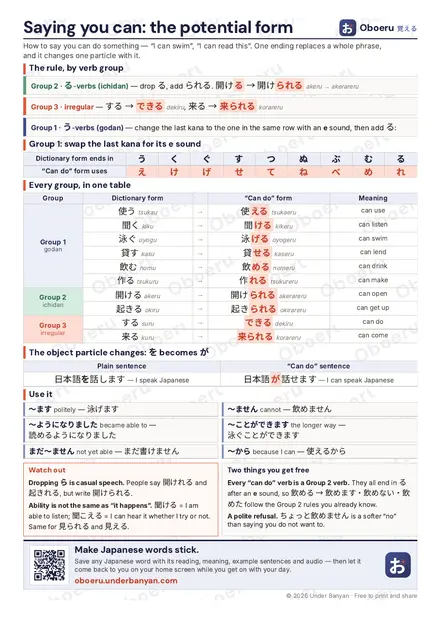
The rule, by verb group
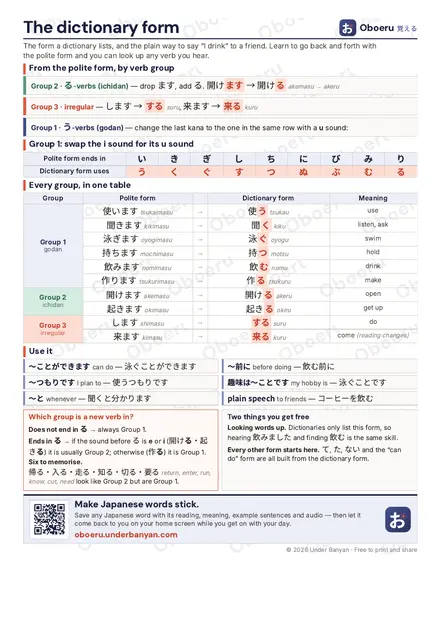
Group 2 · る-verbs (ichidan) — drop る, add られる. 開ける → 開けられる akeru → akerareru
Group 3 · irregular — する → できる dekiru, 来る → 来られる korareru
Group 1 · う-verbs (godan) — change the last kana to the one in the same row with an e sound, then add る:
Group 1: swap the last kana for its e sound
| Dictionary form ends in | う | く | ぐ | す | つ | ぬ | ぶ | む | る |
|---|---|---|---|---|---|---|---|---|---|
| “Can do” form uses | え | け | げ | せ | て | ね | べ | め | れ |
Every group, in one table
| Group | Dictionary form | “Can do” form | Meaning | |
|---|---|---|---|---|
| Group 1godan | 使う tsukau | → | 使える tsukaeru | can use |
| 聞く kiku | → | 聞ける kikeru | can listen | |
| 泳ぐ oyogu | → | 泳げる oyogeru | can swim | |
| 貸す kasu | → | 貸せる kaseru | can lend | |
| 飲む nomu | → | 飲める nomeru | can drink | |
| 作る tsukuru | → | 作れる tsukureru | can make | |
| Group 2ichidan | 開ける akeru | → | 開けられる akerareru | can open |
| 起きる okiru | → | 起きられる okirareru | can get up | |
| Group 3irregular | する suru | → | できる dekiru | can do |
| 来る kuru | → | 来られる korareru | can come |
The object particle changes: を becomes が
| Plain sentence | “Can do” sentence |
|---|---|
| 日本語を話します — I speak Japanese | 日本語が話せます — I can speak Japanese |
Use it
~ます politely — 泳げます
~ません cannot — 飲めません
~ようになりました became able to — 読めるようになりました
~ことができます the longer way — 泳ぐことができます
まだ~ません not yet able — まだ書けません
~から because I can — 使えるから
Watch out
Dropping ら is casual speech. People say 開けれる and 起きれる, but write 開けられる.
Ability is not the same as “it happens”. 聞ける = I am able to listen; 聞こえる = I can hear it whether I try or not. Same for 見られる and 見える.
Two things you get free
Every “can do” verb is a Group 2 verb. They all end in る after an e sound, so 飲める → 飲めます・飲めない・飲めた follow the Group 2 rules you already know.
A polite refusal. ちょっと飲めません is a softer “no” than saying you do not want to.