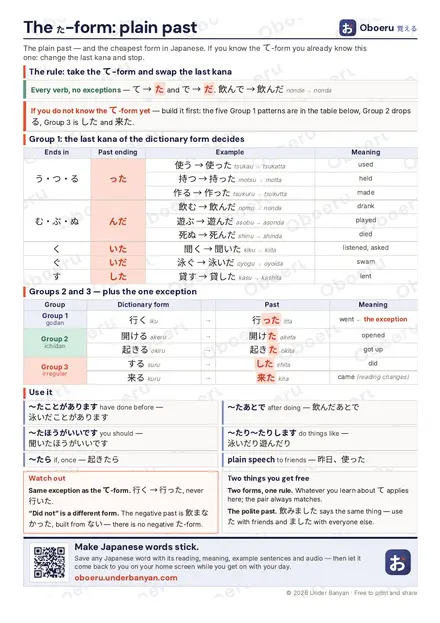
The rule: take the て-form and swap the last kana
Every verb, no exceptions — て → た and で → だ. 飲んで → 飲んだ nonde → nonda
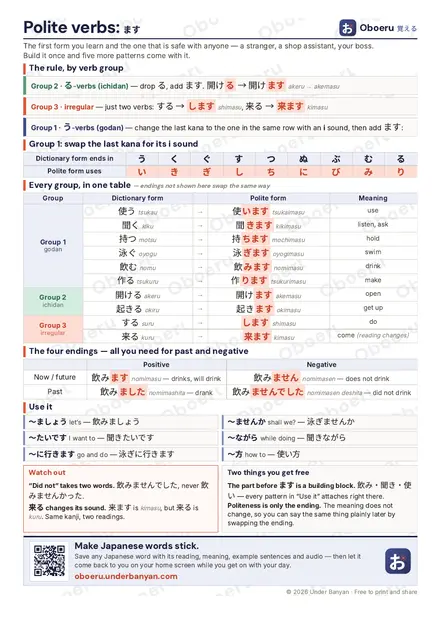
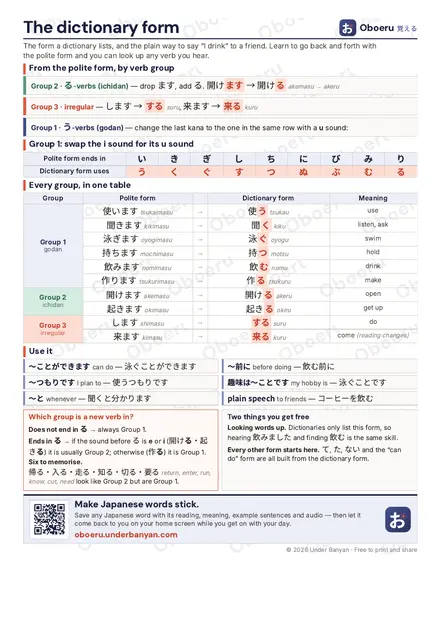
If you do not know the て-form yet — build it first: the five Group 1 patterns are in the table below, Group 2 drops る, Group 3 is した and 来た.
Group 1: the last kana of the dictionary form decides
| Ends in | Past ending | Example | Meaning |
|---|---|---|---|
| う・つ・る | った | 使う → 使った tsukau → tsukatta | used |
| 持つ → 持った motsu → motta | held | ||
| 作る → 作った tsukuru → tsukutta | made | ||
| む・ぶ・ぬ | んだ | 飲む → 飲んだ nomu → nonda | drank |
| 遊ぶ → 遊んだ asobu → asonda | played | ||
| 死ぬ → 死んだ shinu → shinda | died | ||
| く | いた | 聞く → 聞いた kiku → kiita | listened, asked |
| ぐ | いだ | 泳ぐ → 泳いだ oyogu → oyoida | swam |
| す | した | 貸す → 貸した kasu → kashita | lent |
Groups 2 and 3 — plus the one exception
| Group | Dictionary form | Past | Meaning | |
|---|---|---|---|---|
| Group 1godan | 行く iku | → | 行った itta | went ← the exception |
| Group 2ichidan | 開ける akeru | → | 開けた aketa | opened |
| 起きる okiru | → | 起きた okita | got up | |
| Group 3irregular | する suru | → | した shita | did |
| 来る kuru | → | 来た kita | came (reading changes) |
Use it
~たことがあります have done before — 泳いだことがあります
~たあとで after doing — 飲んだあとで
~たほうがいいです you should — 聞いたほうがいいです
~たり~たりします do things like — 泳いだり遊んだり
~たら if, once — 起きたら
plain speech to friends — 昨日、使った
Watch out
Same exception as the て-form. 行く → 行った, never 行いた.
“Did not” is a different form. The negative past is 飲まなかった, built from ない — there is no negative た-form.
Two things you get free
Two forms, one rule. Whatever you learn about て applies here; the pair always matches.
The polite past. 飲みました says the same thing — use た with friends and ました with everyone else.